Watch Writing and Civilization: From Ancient Worlds to Modernity Online

Writing and Civilization: From Ancient Worlds to Modernity
Where to Watch Writing and Civilization: From Ancient Worlds to Modernity

24.
The Future of Writing
2013-09-27
Will typing replace handwriting? Will e-books make printed books obsolete? Will speech-to-text software replace our need to physically write at all? Join Professor Zender as he speculates about the future of writing based on past developments, from the invention of movable type to new signs and spelling conventions inspired by the QWERTY keyboard.

Watch Writing and Civilization: From Ancient Worlds to Modernity Season 1 Episode 24 Now

23.
Medium and Message
2013-09-27
Whether on papyrus, bamboo, clay, stone, or wood, writing shows an important relationship between medium and message. Explore the influence media have had on writing's shape, direction, and use by delving into the origins of terms used for writing implements, the process for making papyrus, the phasing out of scrolls by codices, and more.

Watch Writing and Civilization: From Ancient Worlds to Modernity Season 1 Episode 23 Now

22.
Han'gul, Tengwar, and Other Featural Scripts
2013-09-27
Move from writing systems that developed over time to scripts that were deliberately designed by an individual or group, often for use as a universal system. See how these "featural" writing systems betray their intentional design through an examination of examples including Korean Han'gul, Lodwick's Universall Alphabet, and J.

Watch Writing and Civilization: From Ancient Worlds to Modernity Season 1 Episode 22 Now

21.
Etruscan and Meroïtic--Undeciphered Scripts
2013-09-27
Despite decades of effort by many qualified epigraphers, there are still dozens of undeciphered scripts. Turn to the failures of decipherment and the lessons that can be drawn from them by focusing on the attempted decipherment of two scripts--Etruscan and Meroïtic--which recorded languages with no known relatives or descendants.

Watch Writing and Civilization: From Ancient Worlds to Modernity Season 1 Episode 21 Now

20.
Aztec Hieroglyphs--A Recent Decipherment
2013-09-27
Complex views of Aztec civilization are too often replaced with a one-note narrative that focuses only on the practice of human sacrifice. Look more closely at the system Aztecs invented to write their Nahuatl language, which is still spoken by more than one million modern Mexicans in the form of about a dozen regional dialects.

Watch Writing and Civilization: From Ancient Worlds to Modernity Season 1 Episode 20 Now

19.
What Do the Mayan Glyphs Say?
2013-09-27
How can the strikingly similar structural features of the Mayan and ancient Egyptian writing systems be explained? Continue your exploration of how Mayan writing works through a comparison with Egyptian hieroglyphs.

Watch Writing and Civilization: From Ancient Worlds to Modernity Season 1 Episode 19 Now

18.
Mayan Glyphs--A New World Logosyllabary
2013-09-27
Investigate whether the features of Old World scripts such as Chinese and Japanese, Egyptian hieroglyphs, cuneiform, and Linear B apply to the unrelated scripts of the New World. Focus specifically on Yuri Knorosov's decipherment of Mayan hieroglyphic writing and how living in Cold War Russia both helped and hindered his work.

Watch Writing and Civilization: From Ancient Worlds to Modernity Season 1 Episode 18 Now

17.
Mycenaean Linear B--An Aegean Syllabary
2013-09-27
How did the decipherment of Linear B change perceptions of ancient Aegean civilization? Why are epigraphers still perplexed by many Linear B spellings?

Watch Writing and Civilization: From Ancient Worlds to Modernity Season 1 Episode 17 Now

16.
What Does Cuneiform Say?
2013-09-27
See how scholars revealed a lost world of language and literature when they expanded upon Grotefend's breakthroughs by relating Old Persian to the ancient cuneiform scripts that preceded it. Next, trace the development of writing through 3,500 years of Mesopotamian history, and consider what ancient texts such as The Epic of Gilgamesh can teach us about ancient cultures of this region.

Watch Writing and Civilization: From Ancient Worlds to Modernity Season 1 Episode 16 Now

15.
Old Persian--Cuneiform Deciphered
2013-09-27
Meet Georg Grotefend, a German high school teacher who made an incomparable contribution to the study of ancient writing and civilization. As you investigate the methods he used to decipher Old Persian cuneiform in the Achaemenid texts of Persepolis, delve into a bit of history on this culture's language and the foundation that was already established for the decipherment.

Watch Writing and Civilization: From Ancient Worlds to Modernity Season 1 Episode 15 Now

14.
What Do Egyptian Hieroglyphs Say?
2013-09-27
Join Professor Zender as he reads hieroglyphs that Champollion's efforts helped to recover from oblivion, and see how you too can learn to decipher this blend of phonetic signs, logograms, and semantic signs. Also, consider the interaction of Egyptian writing and culture, including how the practice of damnatio memoriae was used to strike names from official records.

Watch Writing and Civilization: From Ancient Worlds to Modernity Season 1 Episode 14 Now

13.
Egyptian--The First Great Decipherment
2013-09-27
Before Jean-Francois Champollion deciphered hieroglyphic writing in 1822, no one had been able to read a word of Egyptian. Why were Egyptian history and its ancient language and writing system forgotten?

Watch Writing and Civilization: From Ancient Worlds to Modernity Season 1 Episode 13 Now

12.
Bilinguals, Biscripts, and Other Constraints
2013-09-27
Napoleon's expedition to Egypt is most celebrated for its discovery of the Rosetta stone, which contains ancient Greek writing, Egyptian hieroglyphs, and demotic script. Consider this icon of decipherment as the first and most famous example of a biscript, and discover just how common such artifacts are around the world.

Watch Writing and Civilization: From Ancient Worlds to Modernity Season 1 Episode 12 Now

11.
Proper Nouns and Cultural Context
2013-09-27
As you consider the fourth pillar of decipherment, cultural context, see how most epigraphers' efforts begin with the recognition of proper nouns. Then meet the ancient Greek historian Herodotus, and learn how he became the source of much of our information for the cultural context of Old World writing systems.

Watch Writing and Civilization: From Ancient Worlds to Modernity Season 1 Episode 11 Now

10.
The History of Language
2013-09-27
Investigate the importance of language, the third pillar of decipherment, by starting with the story of the decipherment of ancient Sumerian, the language of ancient Mesopotamia. Learn how scholars known as philologists or historical linguists use the comparative method of linguistic reconstruction to compare related languages and reconstruct their shared ancestor.

Watch Writing and Civilization: From Ancient Worlds to Modernity Season 1 Episode 10 Now

9.
Epigraphic Illustration
2013-09-27
As you turn to the second pillar of decipherment--the body of texts available for study--consider how epigraphers find a broad, accurate, and readily accessible corpus to examine. Walk through methods for recording inscriptions, and contrast early and modern illustrations of the Classic Maya site of Palenque in Chiapas, Mexico, to see the evolution of epigraphic illustration.

Watch Writing and Civilization: From Ancient Worlds to Modernity Season 1 Episode 9 Now

8.
The Five Pillars of Decipherment
2013-09-27
First, get an introduction to the five preconditions or "pillars" necessary for decipherment to be possible, paying particular attention to the first pillar, known as script type. Then turn to the typology of the three main categories of signs found across the world--logograms, phonograms, and semantic signs--and consider how these signs are combined in different writing systems.

Watch Writing and Civilization: From Ancient Worlds to Modernity Season 1 Episode 8 Now

7.
What Is Decipherment?
2013-09-27
The earliest writing systems are known to us only through the efforts of archaeological decipherment. But how can archaeologists be certain that the knowledge is accurate?

Watch Writing and Civilization: From Ancient Worlds to Modernity Season 1 Episode 7 Now

6.
Japanese--The World's Most Complex Script
2013-09-27
Borrowed and adapted from the Chinese, Japanese writing is the most complicated script ever devised, yet it's used by more than 100 million people daily. Investigate how and why Japanese writing took on the complex form it has today, why attempts to simplify it have had little success, and why it's unlikely the system will ever be abandoned.

Watch Writing and Civilization: From Ancient Worlds to Modernity Season 1 Episode 6 Now

5.
Chinese--A Logosyllabic Script
2013-09-27
In continuous use for almost 3,400 years, the Chinese script and its derivatives are used by more than 1.5 billon people around the world.

Watch Writing and Civilization: From Ancient Worlds to Modernity Season 1 Episode 5 Now

4.
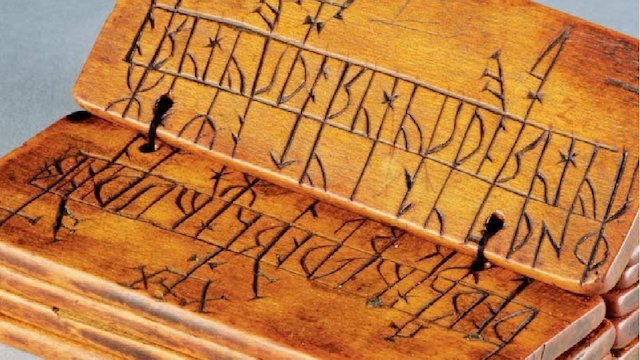
The Fuþark--A Germanic Alphabet
2013-09-27
Runes are often mistakenly thought to be a semimagical system of signs used for divination and ritual, but nothing could be further from the truth. Look at the real history of the Runic alphabet--also known as the Fuþark --as a case study for why writing systems rise and fall.

Watch Writing and Civilization: From Ancient Worlds to Modernity Season 1 Episode 4 Now

3.
Where Did Our Alphabet Come From?
2013-09-27
Most alphabets in use today are derived from one script developed over 4,000 years ago. What accounts for the vast popularity of the Roman or Latin alphabet?

Watch Writing and Civilization: From Ancient Worlds to Modernity Season 1 Episode 3 Now

2.
The Origins and Development of Writing
2013-09-27
Now that you understand the significance of writing, explore three popular beliefs or myths about where writing comes from and how it developed. Investigate the theories of monogenesis versus polygenesis--whether writing was only invented once or independently in locations around the world--and the reasons writing systems are resistant to change.

Watch Writing and Civilization: From Ancient Worlds to Modernity Season 1 Episode 2 Now

1.
What Is Writing?
2013-09-27
It has been said that writing exists only in a civilization and a civilization cannot exist without writing, but is that accurate? Consider the validity of this statement and examine several of the critical functions that writing has served during the past 5,000 years.

Watch Writing and Civilization: From Ancient Worlds to Modernity Season 1 Episode 1 Now

Writing and Civilization: From Ancient Worlds to Modernity is a complex, insightful, and thought-provoking educational course produced by The Great Courses in 2013. It’s an in-depth exploration of the crucial role that writing has played in shaping societies throughout human history. The comprehensive study, made up of 24 lengthy lectures, navigates its way from mankind's earliest symbols' inscriptions to today's digitally driven communication, thoroughly illuminating writing's transformational impact on civilization along the way.

The show seeks to accomplish more than merely outlining the narrative of writing's evolution. It sets out to elucidate, in detail, the contextualization of writing within culture, politics, technology, and the human psychological landscape. Delving into the diverse forms, technologies, and uses of writing that have been devised, the show underscores the intricate relationship between writing systems and their associated societies – offering an incisive analysis of how each could shape the other in profound ways.

Each show's lecture is delivered by Professor Marc Zender, a highly respected scholar in the field of Mesoamerican epigraphy. He is one of the few linguists worldwide who can read Maya hieroglyphs, a talent that lends a particular depth and authenticity to his narration. With wit, passion, and a keen understanding of historical context, Professor Zender takes viewers on a thrilling journey through time and across continents, exploring a variety of cultures and their unique writing systems.

Zender's lectures cover topics ranging from the origins of writing, where he discusses early writing systems like Cuneiform and Hieroglyphs, to the evolution of the Greek alphabet and its impact on literacy. He investigates the fascinating mysteries of lost scripts like Linear A and expands our understanding of often overlooked systems like Maya Hieroglyphs. Moving towards the modern era, Zender delves into how forms of writing such as Guttenberg's printing press and the digital revolution have prompted significant societal changes.

The 2013 course Writing and Civilization: From Ancient Worlds to Modernity also incorporates discussions around the sociocultural and political implications of writing. From exploring how a society's power dynamics can shape its writing systems to examining how literacy and writing access can create social hierarchies, the show offers a holistic, academically rigorous analysis of the intersection between language and power. The impact of writing on fostering national identity, the influence of modern communication technologies on how societies function and evolve is all discussed with the adeptness and sensitivity the topics deserve.

One of the key strengths of the series lies in its ability to make academic learning accessible to a wider audience. While scholarly in content, the show is far from dry academic discourse. Each episode is injected with a sense of storytelling and full of captivating accounts from anthropology, history, linguistics, archaeology, cultural studies, and political science.

Dr. Zender conveys all of this through his enthusiastic and engaging teaching style. He encourages a curious mindset and active participation from viewers, regularly posing thoughtful questions, presenting challenging theories, and incorporating interactive elements. This dynamically turns the passive viewer into an active participant in understanding the interplay of writing and civilization.

The visual component of the course is just as impressive — it complements the audio commentary perfectly. Beautifully crafted animations help illustrate complex concepts, while extensive use of historical photo and video footage bring to life the ancient civilizations under study.

Despite its broad scope and academic orientation, Writing and Civilization: From Ancient Worlds to Modernity is not only for students. Its narrative style, engaging delivery, and relatable content make it appealing to anyone with a general interest in understanding the world around them. Whether you're a history enthusiast, linguistics lover, or just a curious observer, this series offers a chance to forge a deeper connection with the human narrative, establishing an appreciation for the profound influence writing has had on our ability to connect, create, and progress as a civilization.

Writing and Civilization: From Ancient Worlds to Modernity is a series categorized as a new series. Spanning 1 seasons with a total of 24 episodes, the show debuted on 2013. The series has earned a no reviews from both critics and viewers. The IMDb score stands at undefined.

How to Watch Writing and Civilization: From Ancient Worlds to Modernity

How can I watch Writing and Civilization: From Ancient Worlds to Modernity online? Writing and Civilization: From Ancient Worlds to Modernity is available on The Great Courses with seasons and full episodes. You can also watch Writing and Civilization: From Ancient Worlds to Modernity on demand at Prime Video, Apple TV Channels, Amazon online.

Genres
Channel
The Great Courses