
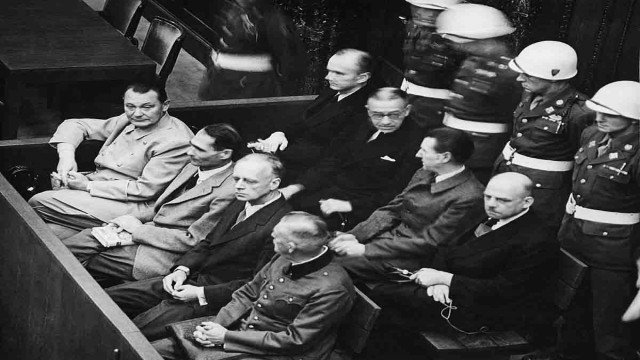
Trial at Nuremberg

Where to Watch Trial at Nuremberg

Judgment at Nuremberg is an exceptionally influential film, representing some of the most ignominious moments in human history. The drama unfolds at the historical backdrop of the post-World War II scenario in 1948, with the focus centered on the Nuremberg Trials. These were a series of military tribunals, held by the Allied forces, aimed to prosecute prominent leaders of Nazi Germany, who were responsible for sustaining the Holocaust and other war crimes.
In the film, we see international law, justice, and humanity themselves on trial. American Judge Dan Haywood, played by Spencer Tracy, is tasked with the monumental responsibility of presiding over the trial of four German judges and prosecutors accused of carrying out atrocities during the war. This ensemble drama gets its gripping tension as Judge Haywood is indefinitely immersed in thought to determine the sentences for the accused German jurists who operated in accordance with the Nazi-compliant law of the time. The narrative raises important arguments about individual and collective guilt, responsibility, and accountability in the face of ethical compromise, incisively questioning the boundaries between obedience and morality.
The movie's emphatic and emotional scenarios are brought to life by a remarkable combination of writing, direction, and performances. Directed by Stanley Kramer, with a screenplay by Abby Mann, Judgment at Nuremberg is an incredibly narrated story where the monstrous reality of the Holocaust is used as the backdrop to question the ethical responsibilities of those who enacted the laws of totalitarian regime. The powerful and star-studded cast includes Richard Widmark, Marlene Dietrich, Maximilian Schell, Judy Garland, Burt Lancaster, and Montgomery Clift. Each performer breathes life into their respective characters, offering uniquely phrased retrospectives on the haunting past that they represent.
A standout from all the impeccable performances is Maximilian Schell, who portrays German Defense Attorney Hans Rolfe. His part, as controversial as it is compelling, ignites significant questions about justice, guilt, and the universal human capacity for both compliance and resistance. Schell's riveting portrayal of Rolfe earned him an Academy Award for Best Actor. Equally mesmerizing are the performances of Lancaster as the subdued, guilt-ridden Judge Dr. Ernst Janning and Widmark as the passionate, righteous prosecutor Colonel Tad Lawson.
Crafted in black and white, the film's cinematography superbly mirrors the moral uncertainties of its plot. Its courtroom scenes, where moral and ethical duels occur, are especially distinct, successfully creating an immersive atmosphere that pulls viewers into the chaos, debate, and dejection that engulfs the courtroom. The film meticulously handles the vast and delicate subject matter, focusing on the humans behind an extreme ideology while refusing to present a simplified version of history.
The film is largely set in a courtroom; however, it transcends the usual limitations of the genre by examining both individual actions and the larger political landscape. The script by Mann utilises the legal drama structure to explore complex moral and ethical issues. The dialogue guarantees an intellectual as well as an emotional confrontation with a disturbing past and an unsettling debate about the nature of guilt and complicity during times of extraordinary evil.
Furthermore, the film's backdrop location, Nuremberg, is symbolically powerful - it is a city that was rendered largely desolate by the Allies' bombs during the war, and it was in Nuremberg where Adolf Hitler once held his notorious mass rallies. The location emphasizes the fall of a mighty and malevolent regime, further accentuating the film's central narrative themes of judgment, guilt, and retribution.
Judgment at Nuremberg, even being more than half a century old, continues to resonate its message worldwide profoundly. It's a vital, provocative examination of the nature of complicity, the communal blame, and the essence of justice. The film is a timeless reminder of how vigilant humanity must be to avoid the recurrence of such atrocities. By focusing on the aftermath of the trials, Judgment at Nuremberg is as much an exploration of justice and morality as it is a subtle exposé of the horrifying depths humans can sink to when adhering blindly to malevolent ideologies. It is a narrative that yearns to ensure the world never forgets, and never repeats, such dark chapters of human history.
Trial at Nuremberg is a Documentary movie released in 1964. It has a runtime of 52 min..
How to Watch Trial at Nuremberg
Where can I stream Trial at Nuremberg movie online? Trial at Nuremberg is available to watch and stream, buy on demand, download at Google Play, YouTube VOD. Some platforms allow you to rent Trial at Nuremberg for a limited time or purchase the movie for downloading.