

Agnivarsha
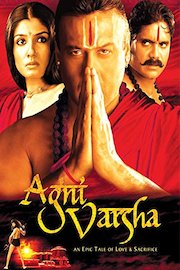
Agnivarsha

Where to Watch Agnivarsha

Agnivarsha: The Fire and the Rain is an evocative and richly layered Hindi film that distills the enchantments of Indian mythology into a contemporary narrative, exploring themes of passion, sacrifice and existential dilemmas. Directed by Arjun Sajnani, the film was released in 2002 and flaunts a remarkable cast, including Amitabh Bachchan and Nagarjuna.
Loosely based on the play "The Fire and The Rain" by one of India’s greatest playwrights, Girish Karnad, the movie is a visual representation of a section of the Indian epic, the Mahabharata. Set against the backdrop of a prolonged drought in a kingdom, the movie embarks on a contemplative journey interweaving human characters and celestial beings, drawing the audience into a world of ancient invocations, divine interventions, power struggles, human frailties and profound philosophical quandaries.
In a virtuoso performance, Amitabh Bachchan embodies Indra, the king of deities. He brings a venerable presence and a grace to the character that radiates divinity in a palpable manner. Bachchan's portrayal is laced with charisma and commands respect, embodying Indra's role as the chief deity in a convincingly majestic manner.
Akkineni Nagarjuna, a leading actor from the South Indian film industry, plays the role of Yavakri. With his brooding and intense portrayal, Nagarjuna brings forth the depth and complexities of his character convincingly. The audience witnesses his transformation through the narrative complexities and his interactions with other characters. Nagarjuna's performance is compelling and resonates with the thematic essence of the story.
Also worth mentioning is the performance by Prabhu Deva, who plays a pivotal role in this feature, with the usual energetic sparkle in his performance that lights up the screen. Other notable characters are embodied by Raveena Tandon, Jackie Shroff, and Milind Soman, who each add a distinct color to the film's overall canvas.
The narrative is immensely aided by the film's impeccable production design that efficiently captures the era it aims to portray. The rustic landscapes, the intricate temple architectures, and the vibrant costumes immerse the viewers into an epoch of forgotten time. The rich background scores and traditional Indian music further enhance the appeal of the cinematic version, which resonates with the core essence of the original play.
The heart of Agnivarsha: The Fire and the Rain lies in its complex interplay of human emotions and desires with the larger contingencies of destiny and divine will. The movie intelligently fosters debates on the nature of good and evil, free will versus destiny, and human suffering as penance or mere consequence of their actions.
Agnivarsha provides an insight into the ethos of a bygone era and takes viewers on a journey where human emotions collide with divine law, painting a picture of the world where the concepts of morality and retribution get harshly tested amid the fires of human frailty and divine interventions.
The director, Arjun Sajnani, delivers a commanding narrative seen seldom in Indian cinema. He combines the ethos of ancient Indian culture with a universal appeal enabling the average viewer to understand and identify with the conflicts and tribulations of the characters. A must-watch for those who seek intellectually stimulating cinema that explores the vast tapestry of human emotions against the backdrop of compelling mythology.
In summary, Agnivarsha: The Fire and the Rain is a cinematic concoction of mythology, philosophy, and human drama. In a unique venture, filmmakers weave a tale rooted in the heart of Indian epics to examine the core of human existence. With a stellar cast and an engaging narrative, this film serves as an experience that transports viewers to a world of ancient traditions, mythical intricacies, philosophical debates, and profound contemplations about life, destiny, and the divine.