

Last Summer Won't Happen
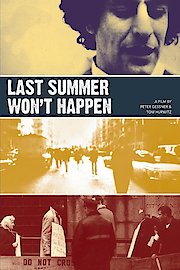
Last Summer Won't Happen
 7.8/10
Where to Watch Last Summer Won't Happen

Last Summer Won't Happen is a gripping documentary directed by Peter Gessner and Tom Hurwitz released in 1968. This film chronicles the summer of 1967 in the East Village of New York City, a time marked by social and political turmoil that galvanized a generation, serving as the harbinger of the fierce youth-driven countercultural movement.
This documentary offers a panoramic view of this turbulent time without employing the traditional narrative structure. Instead, it features a series of first-hand descriptions and perspectives from notable activists and proponents of the counterculture movement, offering an unfiltered lens into this pivotal moment in American history.
Some of the key figures in the film are Abbie Hoffman and Paul Krassner, who went on to co-found the Youth International Party or "Yippies," as well as Tom 'Osha' Neumann, a prominent figure in the bohemian and leftist circles of the East Village during the late '60s. These protagonists offer an intimate view on some of the significant themes of the time: political activism, civil rights, Vietnam War protests, psychedelic experimentation, and the overall rebellion against the mainstream societal norms.
Abbie Hoffman, well-known for his leadership in the anti-establishment and countercultural movements, is one of the central characters in the film. Hoffman's radical activism and unabashed disdain for the political and societal status quo resonate through his dialogue and actions in the documentary. He provides insight into the motivations behind the counterculture movement, shedding light on the spirit of rebellion that defined his generation.
The inclusion of Paul Krassner, another standout counterculture figure and founder of the satirical publication The Realist, adds depth to the narrative. Krassner's biting satire and unapologetic social commentary provide viewers with a unique perspective on how humor and wit were harnessed as weapons against what was perceived as an oppressive societal system.
Viewers also get to witness Tom 'Osha' Neumann's philosophical and intellectual contributions to the counterculture movement. Neumann, a prominent anarchist scholar and an influential figure in the East Village scene, provides a thought-provoking analysis of the political climate and societal unrest of the time.
The film draws its strength from its raw, unscripted dialogues and a vérité style of filmmaking. This approach brings critical authenticity to the film, mirroring the unvarnished truth and reality of the counterculture uprising as it happened. From smoky activist meetings and vibrant protest rallies, to passionate debates about non-conformity and radical politics, the film truly captures the zeitgeist of this volatile period.
The filmmakers’ emphasis on the human voices and experiences of 1967 paints a picture of a society in flux. The film successfully captures the sense of urgency, anticipation, bewilderment, and fervor that characterized this turbulent time, creating a time capsule that transports its viewers back to a crucial turning point in the nation’s history.
Last Summer Won't Happen also chronicles the famous Summer of Love, a social phenomenon that saw thousands of young people, predominantly known as "hippies," converge in San Francisco. This event, marked by free love, music, and an exploration into alternative lifestyles, is documented in a way that adds an intriguing layer to the movie's rich tapestry, providing broader cultural context and deepening our understanding of the countercultural revolution.
Last Summer Won't Happen is more than just a documentary; it is a testament to a transformative period that would shape America's counterculture landscape. It encapsulates a volatile moment in history through the words of the very individuals who dared to challenge societal norms and the status quo. This is a must-watch for those interested in history, politics, social movements, and the exploration of counterculture ideologies that continue to leave an indelible mark on the societal canvas.
7.8/10