
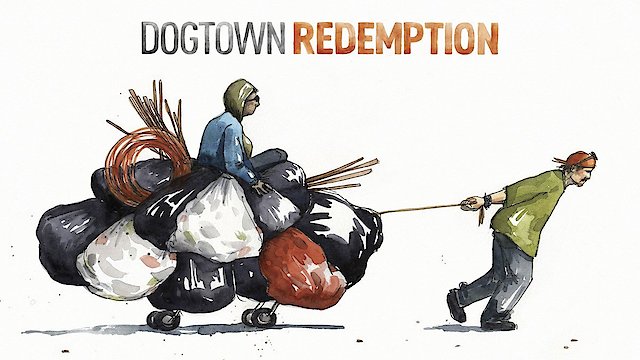
Dogtown Redemption
Dogtown Redemption
""...the street's gonna pay me.""
 8.0/10
Where to Watch Dogtown Redemption

Dogtown Redemption is an American documentary film of 2015, directed by Amir Soltani and Chihiro Wimbush. The film focuses on the lives, struggles, and hopes of a unique group of marginalized individuals in Oakland, California, allowing audiences to delve into the seldom-explored world of street-level recyclers. The film stars a trio of real-life individuals whose everyday realities give depth to the human spirit: Landon Goodwin, Hayok Kay, and Jason Witt.
Landon Goodwin, a former minister turned street recycler, plays a central role in Dogtown Redemption. His compelling journey unfolds as he bravely battles his struggles and vulnerabilities, endeavoring to transform his life. A storyteller by nature, Goodwin's eloquence and charisma invite viewers to sympathetically consider his experiences from his perspective.
Moreover, we get to meet Hayok Kay, an artist and immigrant from Korea. Facing both physical and mental health issues, her overwhelming passion and commitment to art shape her into an inspiring and resilient figure despite her circumstances. Kay's story deeply resonates, showing the struggle of marginalized immigrant workers in America.
Also featured is Jason Witt, the youngest protagonist of the three, who belongs to Oakland's hereditary underclass. Raised in a family with a deeply-rooted in poverty history, Witt narrates his experience of resorting to recycling as a survival strategy. Jason's narrative provides a poignant exploration of generational poverty, its inherited nature, and his attempts to break free from its shackles.
Dogtown Redemption is as much about these individuals as it is about the city of Oakland itself. The documentary peels back layers of the city, revealing the poverty, stark inequality, and quiet desperation that often lurk unnoticed in the shadows of prosperity. This emotional, eye-opening documentary takes us through the harsh realities of the city, offering an intense, gritty look at a world that few take the time to fully understand or appreciate—those who make their living by scavenging the streets for recyclables.
Nested in the broader context of the film, the city's recycling yard, Alliance Metals, is positioned as an essential backdrop against which these stories play out. For many of Oakland's street recyclers, the yard serves as an economic lifeline, a community center, and a place of redemption.
Not just confined to bravely documenting the stark realities of its subjects, Dogtown Redemption also subtly critiques the broader societal structures, marginalization, and discrimination that contribute to their circumstances. It takes on the hard task of humanizing individuals often dismissed or ignored by society at large, providing a harrowing lens into the real-world repercussions of class division and the economic disparities in America.
However, the film also succeeds in highlighting the resilience and perseverance of its protagonists. Despite battling prejudices, economic hardships, and sometimes their personal demons, Goodwin, Kay, and Witt's efforts to reclaim their lives serves as a testament to the enduring human spirit. Their stories are proof that even in the most challenging circumstances, hope and redemption are possible.
Visually compelling and deeply moving, Dogtown Redemption crafts a poignant narrative mosaic, pulling at heartstrings while cajoling audiences into pondering society's uncomfortable truths. What may initially seem like a film about street recyclers rapidly reveals itself to be a powerful exposition on socio-economic conditions, marginalization, and ultimately, the human struggle for survival and dignity.
With its intimate, respectful storytelling approach, Dogtown Redemption serves as an engaging and jarring social document. It vibrantly showcases the little-seen underbelly of American cities, lifting the veil to expose the neglected strata of society often passed over by mainstream cinema. Directed unflinchingly yet with great empathy, Soltani and Wimbush's film successfully stirs compassion and understanding for those who live on society's peripheries in their fight for survival, dignity, and redemption.
In conclusion, Dogtown Redemption enlightens its spectators about the reality of extreme poverty, right in the heart of one of the wealthiest countries in the world as it offers viewers a window into the seldom-seen and even less understood world of street life. It is a humbling, heart-rending, and ultimately humane examination of individuals who, despite being pushed to the edges of society, refuse to be defined solely by their circumstances.
8.0/10