

Railroad of Hope
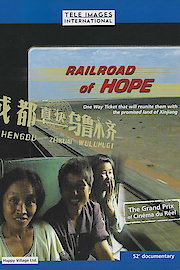
Railroad of Hope
 7.6/10
Where to Watch Railroad of Hope

Railroad of Hope is a compelling 2001 documentary directed by acclaimed Chinese director, Ning Ying. The film provides a unique exploration of rural China and its residents' hopes, dreams, and journeys for a better life in the highly urbanized city of Xinjiang, thousands of miles away. While most modern films focus on the urban changes and economic development occurring in the major cities of China, this documentary digs deep into the realities and hardships of Chinese individuals living in underprivileged rural areas, illuminating their struggles, courage and resilience.
The title, 'Railroad of Hope,' is symbolic of the paradox between a desolate and impoverished rural community and the aspiration of its people for prosperity. The film largely centers on the narrative of migrant laborers, who annually travel along the 2000-mile railway from Lanzhou, in West China, to Xinjiang Uygur Autonomous Region in the North-West, seeking seasonal work during the cotton harvest.
One of the distinctive aspects of 'Railroad of Hope' is the intimate and deeply personal portrayals of its subjects. The film originally begun as an unbiased observation of these migrant workers but gradually evolved into sharing their personal narratives, hopes and dreams as they embarked on these extensive journeys. Dramatic moments are punctuated with extended close-ups of the travellers, their faces etched with the stories of their lives, their dreams for prosperity, and the uncertainty of their future.
Ning Ying, through her particular style of filmmaking, subtly unfolds a remarkable panorama of the economic disparity between urban and rural China. The film does not employ an outright critique or judgment of the situation; instead, it silently witnesses the high cost of dreams and the harsh contrasts illuminated between rural and urban areas. The irony lies in the hope that is intrinsically attached to the railway - marking a new beginning for some while serving as a symbol of despair for others.
The narrative style of the Railroad of Hope is unique in that it doesn't rely on a traditional linear storytelling niche. Instead, viewers are introduced to various characters at different intervals - all related by their shared pursuit of better opportunities. These storylines are often neatly interwoven, painting a broad palette of personal experiences. Despite, or perhaps because of, the many characters featured, the film feels more like a mosaic of human experience than a standard narrative.
The cinematography of the Railroad of Hope is visually striking. The camera lens captures the wide, barren landscapes of rural China, creating a stark contrast against the crowded and confined spaces of the migrant trains. There's an impressive visual juxtaposition between the vast Chinese territories' barrenness and the trains' overcrowded compartments, filled with hope and anxiety.
The sound design is an additional noteworthy aspect of the film, alternating between periods of silence and coordinated soundscapes. The rumbling of the train engines, the hushed murmur of conversation, and the periodic haunting silence all work together to create an immersive and tactile cinematic experience.
Through the Railroad of Hope, Ning Ying reveals the often overlooked facets of Chinese society: the struggle, the hope, the disappointment, and the resilience of the rural migrants. The exploration of societal and economic contrast between urban life in Xinjiang and its rural counterpart is highlighted with such gentle subtlety that it's an unwritten commentary on the region's socio-economic pulse. Ning's observational method of filmmaking and perspective allows viewers to form their personal interpretations of the scenes and the migrant workers' plight.
In conclusion, Railroad of Hope is a poignant and deeply moving documentary that sheds light on the lesser-known stories of rural migrant workers in China. It is a testament to the power of hope and the human spirit's resilience. The blend of storytelling, compelling characters, breathtaking cinematography, and subtle social commentary make it an essential watch for those curious about the truths – both bitter and hopeful - residing in the heart of China's economic development. Ning Ying's cinematic language is both universal and personal, making 'Railroad of Hope' a timeless artifact of human journey and sacrifice.
7.6/10