
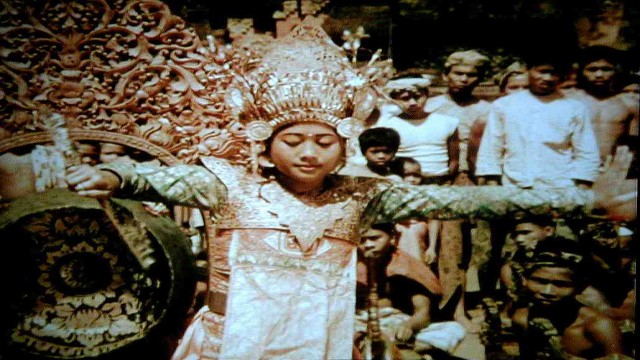
Legong: Dance of the Virgins

Where to Watch Legong: Dance of the Virgins

Legong: Dance of the Virgins is an enthralling 1935 American silent film directed by Henry de la Falaise. This notable masterpiece was shot entirely on location in Bali, Indonesia, featuring a rich and detailed portrayal of the local culture, customs, and traditions.
This silent drama resonates with the rhythm of the traditional Balinese music, known as Gamelan, which plays an integral part in the structure and mood of the movie. Its visual narrative showcases the region's artistic grandeur using native actors and actresses, with the lead roles performed splendidly by Poetoe Aloes Goesti, Bagus Mara Goesti, and Saplak Njoman.
In terms of narrative, Legong: Dance of the Virgins is, primarily, a tragic love story. It revolves around the lives of two sisters, Poutou (Poetou Aloes Goesti) and Saplak (Saplak Njoman), who fall in love with the same man, a charming young musician called Njong (Bagus Mara Goesti). This notable narrative structure reveals the complexities woven around the protagonists owing to the cultural constraints and the inherent love triangle that masquerades as a period Bali drama.
The term "Legong" refers to a type of traditional Balinese dance performed by young girls, often as a precursor to their coming-of-age. Intriguingly, the beautiful Poutou is destined to become a Legong dancer, an honor that comes with significant personal sacrifice, impacting the course of her love life and relationships.
Throughout the movie, viewers are granted an intimate glimpse into the village life, spectacular landscapes, and intricate ceremonies of Bali. The integrated color process allows the audience to experience the lush vibrancy of the island's natural beauty in depth. Look for unique elements that comprise the Balinese lifestyle: the ritualistic preparation of food, the dedication to the arts, and the profoundly spiritual practices that pervade daily life.
While many silent films faced extinction with the advent of "talkies," Legong: Dance of the Virgins holds its own due to the elaborate details it presents about an exotically different culture. Henry de la Falaise's expert craftsmanship is evident in every frame, with its formidable script appealing to the aesthetics of ardent picture-goers. The director's meticulous planning and execution become apparent in his sequential use of two-strip Technicolor negatives, a variety of angles and distances, and an atmospheric nighttime scene lit entirely by locally-made lamps.
The performances of Poetoe Aloes Goesti, Bagus Mara Goesti, and Saplak Njoman are stunning, as they maneuver through the narrative with grace and emotion that overcome the linguistic barrier. Their performances are preserved beautifully in the celluloid, which makes this film a valuable cultural and historical artifact.
It's also critical to mention the technical aspects of the film reflecting the evolving phase of cinema during the mid-'30s. The use of Two-strip Technicolor gives the film a sort of ethereal glow, magnifying the exotic allure of the narrative and its geographical setting. The detailed art design, set pieces, and costumes reflect the authentic Balinese environment, adding remarkable depth to its viewing experience.
With its innovative cinematography, compelling performances, captivating plot, and detailed depiction of Balinese culture, Legong: Dance of the Virgins is a timeless slice of cinematic history. This film truly showcases the art of silent storytelling, ensuring a tantalizing experience for anyone interested in both global cinema and world cultures.
Legong: Dance of the Virgins is a Drama movie released in 1935. It has a runtime of 54 min. Critics and viewers have rated it moderate reviews, with an IMDb score of 6.5..
