

Her Majesty's Sergeant
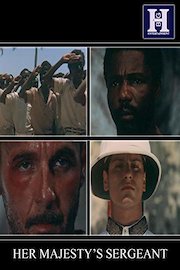
Her Majesty's Sergeant

Where to Watch Her Majesty's Sergeant

Her Majesty's Sergeant is a World War II themed cinematic narrative packed with historical accuracy, rich character study, and gripping storytelling. The film, directed by respected Ghanaian filmmaker, Segun Soyinka, and starring notable actors Tommy Ebow Ansah and Surinder Singh Ghuman, is based on true events and is one of the crucial entries in the genre of war cinema.
Set against the backdrop of World War II, Her Majesty's Sergeant is an immersive portrayal of the struggles of the African and Indian soldiers who were part of the British Commonwealth troops. The narrative centers on two main characters, Ghanaian Jacob Thomas (Tommy Ebow Ansah) and Indian Harbans Singh (Surinder Singh Ghuman), both of whom fulfill their roles with a stellar performance that allows viewers to truly understand their journey as war soldiers a long way from home.
Ansah's portrayal of Jacob Thomas is notable. He's been a farmer in a small village in British-administered Ghana, leading a peaceful life until the war hits. Eager to support the British empire and driven by the promise of a bountiful future, he enlists in the British army, thereby marking his journey from a calm village in Ghana to the chaotic battlegrounds of Burma. Ansah's performance excellently captures the evolution of his character—from a hopeful novice to a seasoned soldier struggling with the realities of war, creating a profound emotional resonance with the audience.
Ghuman's Harbans Singh is from the Indian subcontinent, and his character too undergoes a transformation just as tangible. The actor's nuanced performance adds depth to Singh, shedding light on his experiences and perspectives. As an Indian soldier stuck in the same quagmire of battle, betrayal, and survival as his African counterpart, Singh's struggles are as much a focus of the narrative as Thomas'. As the film progresses, their bonding amidst the calamities of war forms the emotional core of the narrative.
The beauty of Her Majesty's Sergeant lies in the directors' sophisticated story-telling techniques, where they don't just showcase the ravages of war but situate it within the larger context of colonial politics. As the storyline goes deeper into the interaction of race, politics, and war, it accurately reflects the inequalities and exploitations of the period. These complexities are explored through the solid lead characters, thereby providing an immeasurable depth to the narrative structure.
Moreover, the cinematography in Her Majesty's Sergeant smoothly captures the transition from the tranquillity of Ghanaian farmlands to the turmoil-filled battlefields of Burma. Stirred in with an apt sound design and score, it creates an immersive backdrop that aids in bringing to life the contrasting environments and the upheaval that was World War II.
With a strong supporting cast of African, Indian, and Western actors, Her Majesty's Sergeant truly takes a global approach to its depiction of war. It is not just a tale of braveness during war times, but also a commentary of the socio-political context of that era. It does more than weave a narrative of two soldiers; it depicts the uniforms they bear more than as mere cloth and metal but as symbols of colonialism, hierarchy, race, and identity. It's an exemplary tale that pays tribute to the African and Indian soldiers who have not been much celebrated in the discourse of WW II, while simultaneously criticizing the system that used them as mere pawns in the pursuit of power and control.
In conclusion, Her Majesty's Sergeant is a multi-layered, thought-provoking film that explores the individual journeys of African and Indian soldiers during World War II, put forth through compelling performances, meticulous direction, and rich storytelling. It beautifully encapsulates the shared histories and experiences of the colonized, making it a must-watch for those keen on war films, historical dramas, and poignant narratives that provoke deeper analysis.