

Deep Jele Jaai
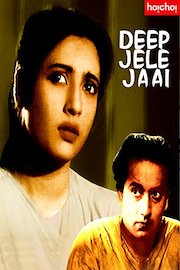
Deep Jele Jaai

Where to Watch Deep Jele Jaai

Deep Jele Jaai is a classic Bengali drama film that was released in 1959. The movie, directed by the legendary Asit Sen, features the stalwarts of Bengali cinema, Suchitra Sen and Anil Chatterjee in the lead roles. The title "Deep Jele Jaai" translates to "Let the Lamp Keep Burning," setting the tone for the insightful and progressive storyline.
In this film, Suchitra Sen plays Radha, a nurse with an endearing persona, working at a psychiatric clinic in Kolkata. Radha's unique method of treating patients sets her apart from her colleagues. She empathizes deeply and conveys genuine concern for her patients, leveraging the bond of trust to make them talk about their fears and anxieties, thus aiding their healing process. She is completely devoted to her profession and goes beyond her call of duty to provide the best possible care.
Enter Tapash (played by Anil Chatterjee), a wealthy man driven to insanity by a heart-wrenching past. As Radha takes up the case, she unravels layers of his conflicting emotions, melancholic past, and his traumatizing experiences of unrequited love. She uses her characteristic approach to coax him into a conversation and gradually cures him. However, her passionate involvement with Tapash's life leads her to unintentionally blur the professional line, and she finds herself deeply enmeshed in his tragic past.
Suchitra Sen, one of the greatest actresses in Bengali cinema of her era, gave one of her finest performances in Deep Jele Jaai. Her portrayal of the complex character Radha with such finesse and sensitivity, notwithstanding her inner turmoil and emotional vulnerability, reflects the depth of Sen's acting. Anil Chatterjee, on the other hand, seamlessly transitioned from a tormented, mentally unstable man to a healed heart, making his role believable and impactful.
While the film focuses primarily on psychology and mental health, it also gives a fresh perspective on the concept of love and sacrifice. It pushes the boundaries of societal norms and delves into the complexities of human emotions, the thin line between sanity and insanity, thus succeeding in providing a mature, unique, and nuanced narrative. Asit Sen's insightful direction and careful storytelling make the movie a timeless classic. It is punctuated by soul-stirring Bengali songs which enhance the emotional depth of the film.
The film’s cinematography needs special mention since the black and white frames help maintain the intense and somber mood of the film. Each frame in this movie is a classic archive of how camera angles and lighting can be used to highlight the different emotions actors experience. Meanwhile, the lighting and scene compositions create a feeling of suspense and mystery reminiscent of Gothic literature.
The screenplay digs deep into the human psyche, unfolding the narrative subtly yet significantly. Throughout the film, there is a constant reminder of how the line between caregiver and patient becomes blurred, particularly when the professional trajectory crosses with the personal. The film's dialogues are not only memorable but also philosophically profound, sometimes haunting the audience much after the film has ended.
Deep Jele Jaai is a landmark in India's cinematic history for its take on mental health, a subject that wasn't common in the '50s. It broke several stereotypes and taboos and laid the foundation for many future films exploring similar themes.
In a nutshell, Deep Jele Jaai showcases brilliant performances, light and shadow nuanced cinematography, gripping screenplay, and soulful songs. It's a must-watch for cinema lovers and boasts of a narrative that leaves the audience pondering. The film’s exploration of human emotions, the internal struggles of the characters, and their journey towards healing are what makes Deep Jele Jaai a memorable cinematic experience. It stands as one of the gems in Indian cinema that has withstood the test of time and continues to be appreciated by a modern audience, proving that classic art really is timeless.