
A Trip Down Market Street
A Trip Down Market Street
 6.9/10
Where to Watch A Trip Down Market Street

A Trip Down Market Street is a unique journey back in time that poignantly portrays the bustling environment of San Francisco in 1906, a few days before the devastating earthquake. The movie provides an insightful glimpse into everyday city life during an era largely relegated to history books and sepia photographs, offering viewers an unadulterated direct interface with the past.
This movie on a reel of 35mm film runs about 13 minutes long and is a silent film, a common feature of the formative years of cinematic artistry. This simple yet profound film showcases the complexity and dynamics of urban life more than a century ago. It's like a moving time capsule, providing a raw unedited view of a period quite often romanticized in literature and glossed over in our collective memory.
The film essentially takes you on a virtual tour on a cable car cruising down Market Street, one of the primary locales in downtown San Francisco. Fitting to its title, the movie begins at 8th street and logically progresses towards the Ferry Building at the east end of the street.
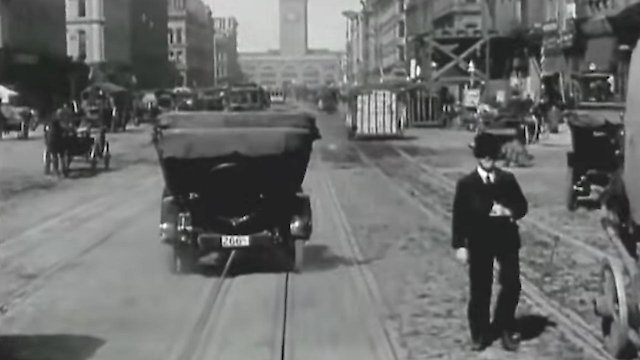
Throughout the film, the viewer is exposed to an assortment of sights and sounds unique to the epoch. We encounter pedestrians confidently navigating the traffic-laden streets, cable cars and horse-drawn carriages adding to the kinetic overlay of the cityscape, and dapperly dressed men adorned in three-piece suits with hats, contrasting against women in their long Victorian dresses and fancy hats — such details which one can now only associate with period pieces and the bygone era.
One would typically expect a chaotic cacophony of a city teeming with people and vehicles. However, the silence of the film creates an eerie calmness that accentuates the visuals and brings out an amplified focus on the observational details. In the absence of dialogue, your attention will be naturally drawn to the nuances, gestures, and movement happening within the framework of the screen.
Surprisingly, the scope of automobiles notably dotting the landscape, argues against the tech-naïvety one generally associates with the era. You would be fascinated to note how the citizens of the day, skillfully juggled between the methods of transportation- be it automobiles, horse-drawn carriages or electric street cars.
Along the journey, ornate Victorian buildings, conspicuous for their architectural grandeur, flank both sides of the street, providing a rich backdrop to the rhythmic cadence of the moving images. Occasionally, the camera captures children fixated on the camera or bicycle riders, remarkably unfazed by the surrounding happenings, adding a touch of warmth to the otherwise mechanical city life.
Towards the end, the film peaks at the Embarcadero, teeming with life, offering a panoramic view of the ferry-filled harbor — one of the main transit hubs of the city. Many would find this picture reminiscent of today's views, feeding into the notion of how certain aspects of life transcend the barriers of time.
Watching A Trip Down Market Street, will give you an deeply impressionable visual experience. It serves as an historical artifact, presenting an intriguing spectrum of life that takes you through Market Street's modulations — from its bustling chaos to its synchronized physical patterning, giving you a strangely contemporary experience of life in 1906's San Francisco.
Above all, what makes the film poignant are the historical events that shadow it. The fact that this film was shot only days before the Great San Francisco Earthquake which ravaged the city invokes an undeniable emotional tinge, lending an almost surreal aura to your viewing experience.
A Trip Down Market Street is indeed a cinematic experience that goes beyond simple entertainment. It is a snapshot of a moment in time, an unparalleled chance to observe and appreciate the everyday being of a long-past era, reconciling with the inevitability of change and yet seeing semblances of the present in the supposed simplicity of the past. The overall takeaway from the film is not only a keen understanding of social history, but a broadened perspective of human resilience and evolution.
6.9/10