

8 1/2 aka Fellini's 8 1/2
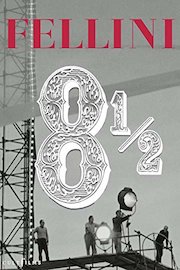
8 1/2 aka Fellini's 8 1/2

Where to Watch 8 1/2 aka Fellini's 8 1/2

8 1/2, also known as Fellini's 8 1/2, is a celebrated Italian film directed by the legendary Federico Fellini. Released in 1963, the film stars Marcello Mastroianni, Claudia Cardinale, Anouk Aimée, and Sandra Milo. Celebrated for its innovative narrative structure, its strikingly beautiful cinematography and its ambitious exploration of selfhood and creativity, 8 1/2 continues to be revered in global discussions of cinema.
Underneath the lens of his timeless and unique storytelling ingenuity, Fellini examines the chaotic, beautiful, perplexing and often surrealistic spectrum of human consciousness with this picture. The title of the film itself pays tribute to the director's previous filmography, referring to the number of films Fellini had made these far; six features, two shorts (equating to one feature), totaling to “eight and a half”.
Marcello Mastroianni shines as Fellini’s alter ego, Guido Anselmi, a renowned Italian film director who finds himself in both a creative and personal crisis. Plagued by the pressure of expectations tied to his upcoming science fiction film, recurring headaches, and an estrarium of complicated personal relationships, Guido navigates through the murky waters of the creative process, wrestling with a parade of memories, whims, and fears.
Claudia Cardinale features as Claudia, a serene woman etched in Guido's imagination who serves as both his muse, his source of inspiration, and his ideation of an ultimate goal. Guido navigates the complex dynamics of his turbulent wife Luisa, played by Anouk Aimée, and his mistress Carla, played by Sandra Milo, alongside the growing pressure he faces from his daunting, expectant film crew.
The narrative beautifully interweaves reality and fantasy as Guido escapes from the unyielding pressure into a labyrinth of intricate fantasies and past memories. One moment, you are in the midst of the chaos of the film set, punctuated by the cacophony of professional tensions, and in the next, Guido is drifting into one of his maze-like dreams or flashbacks. This provides profound insights into our protagonist's psyche.
The film is not traditional in its storytelling approach. Unlike the conventional linear narrative pattern, 8 1/2 unfolds non-linearly, pivoting between past and present, dreams and reality, truth and fiction. The film’s unconventional narrative structure is testament to Fellini's filmmaking genius and foresight, leading the viewer along with Guido on this complex existential journey.
8 1/2 is a film of duality. It celebrates and scrutinizes the joyous chaos of the creative process as well as the burdens it encompasses. It is a self-portrait and social commentary, a comedy and a tragedy, a dream and a nightmare, embodying Fellini's trademark blend of the fantastic and the real.
Visually arresting, the film is a cinematographic gem, boasting exquisite black-and-white visuals and grand, elaborate set designs. Owing to Fellini's background as a cartoonist, his characters are visually distinctive, ranging from the ordinary to the oddball, each presenting a colorful and crucial part of Guido’s world.
8 1/2 is an introspective, metaphysical journey that doesn't shy away from contemplating existential themes such as mortality, identity, and the nature of art itself. Its reverie-like narrative and bold aesthetic choices have often made audiences perceive it as a film ahead of its time, a cinematic marvel that challenged the established norms.
Replete with references to film, theatre, and art, 8 1/2 is also a reflection on the nature of cinema, offering sharp, sophisticated insights into the film industry. Its examination of the wavering boundary between art and life, imagination and reality, personal and public, contributes to its enduring relevancy and appeal to avid film enthusiasts.
With its dreamlike narrative and musings on art and life, 8 1/2 might seem ambiguous to some viewers, but that’s where its charm lies. It is an odyssey into the celebration of life’s absurdity, a deftly woven tapestry of extraordinary creativity, and the teetering balance between sanity and madness that often accompanies it.
In conclusion, 8 1/2 stands as one of the greatest offerings of Italian and global cinema. Featuring stellar performances, innovative narrative techniques, and stupendous, haunting imagery, it profoundly captures a director’s struggle, his intrinsic relationship with his art, and the poignant surrealism of life. It is a movie that must be viewed at least once for any cinema aficionado, and the true magic lies in its ethereal ambiguity - there are as many interpretations as there are viewers.