
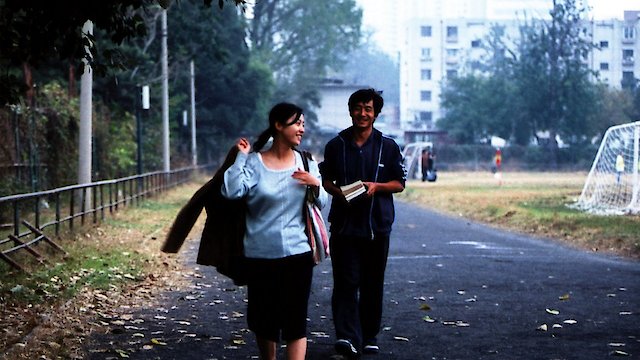
Summer Palace
Summer Palace
"Where did our love go…"
 7.2/10
 79/100
Where to Watch Summer Palace

Summer Palace from 2006 is a deeply evocative and moving film that delves into the world of youthful romance, political upheaval, and personal discovery. It is directed by the influential Chinese filmmaker, Lou Ye, and stars the talented trio of Lei Hao, Xiaodong Guo, and Xueyun Bai. The story follows the life of Yu Hong, a young woman from a small provincial town in China who goes to university in Beijing and experiences the tumultuous events of the late 1980s and 1990s China.
As the movie begins, we are introduced to Yu Hong (Lei Hao), a naive and impulsive young woman in her teenage years, growing up in Tumen. Her life takes a big turn when she gets admitted to a university in Beijing. The shift from a small town to the bustling city provides the setting for the film to explore her coming-of-age journey. Leaving her sheltered life behind, Yu Hong becomes involved in a passionate and tumultuous love affair with Zhou Wei (Xiaodong Guo), a fellow student her age.
The relationship between Yu Hong and Zhou Wei forms the backbone of the narrative. Their interactions are quickly characterized by intense love, passionate romance, and inevitable heartbreak. Lei Hao and Xiaodong Guo deliver stirring performances that touchingly depict the sheer intensity of first love, and its life-altering consequences. Filming these intense, complicated emotions, director Lou Ye captures the raw energy of young love on the verge of decay, twinned by the backdrop of a country struggling through its own transformation.
As the personal narratives unfold, the story of Summer Palace simultaneously chronicles the political situation in China during that period. Notably, the infamous Tiananmen Square incident, which surfaces as a turning point in the film, is portrayed with a unique perspective. The political condition in the background somehow parallels the tumultuous relationship of Yu Hong and Zhou Wei, mirroring the way individual lives are intertwined with their wider national context.
The brilliance of Summer Palace also lies in its cinematic scope. Lou Ye expertly weaves together close-ups and wide shots, creating an absorbing narrative filled with intimate moments and panoramic scenes. The film offers a stunning visual experience with its masterful cinematography that blurs the line between reality and surrealism, illuminating the evocative nature of the story being told. The top-notch production values, coupled with the unforgettable performances, make the film a remarkable cinematic achievement.
One striking aspect of the film is the attention to detail in representing the cultural and social changes occurring in late 20th Century China. From the characters' outfits to the urban architectural background, every detail in the film contributes to the creation of a realistic appearance. At the same time, the film is imbued with a poetic ambiance, often bordering on the melancholic, which further deepens the emotional impact on the audience.
In addition, the personal journey of the main character, Yu Hong, as she navigates her way through intense personal relationships and the changing socio-political climate, forms an essential part of the narrative. Her experience reflects the struggles and aspirations of an entire generation. By the end of the film, you're left with the realization that the story is as much about Yu Hong's journey towards self-discovery and independence as it is about China's tumultuous historical period.
Overall, Summer Palace from 2006 is an intense exploration of love, revolution, and personal growth. Despite its somewhat controversial portrayal of political events and explicit depictions of romance, the film manages to illustrate universal themes of passion, heartbreak, and the struggle for freedom and personal identity. It's a powerful and moving drama that takes you on an emotive journey fueled by love, pain, and hope. Every aspect of the film from its dramatic narrative, sincere performances, and astounding visual aesthetic succeeds in portraying the seeds of rebellion and the throes of first love in a time of revolution.
7.2/1079/100