

Saint Matthew Passion
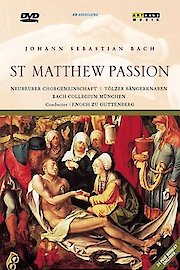
Saint Matthew Passion
 7.2/10
Where to Watch Saint Matthew Passion

Saint Matthew Passion is an artistic movie by directors David and Albert Maysles, released in 1966. It's a documentation of performance that explores the boundaries between film and music, combining heightened dramatic intensity with religious undertones and stunning visuality, proving that orchestras could be movies before becoming mainstream.
This film doesn't merely depict a performance; it's a film experience unto itself that goes beyond the visual account of Johann Sebastian Bach's legacy, known as one of the greatest contributions to Western classical music. It is a tale of love, bereavement, and redemption, ultimately providing the audience with a unique perspective on the famous musical composition — St. Matthew Passion of 1727.
Saint Matthew Passion is set against the backdrop of the Easter season, combining earthly realities with divine interventions and the profound beauty and depth of human feelings. The directors have worked meticulously to stage the drama maintaining the sanctity and gravity of the original music, showcasing the power of music to heal, to provoke thought, and to move the human spirit. The film portrays the core composition - the Gospel of Matthew from the New Testament, which tells the story of Christ's last days on Earth.
One of this film's unique elements is that it's a 'performance documentary', a rare genre, even in contemporary cinema. The very nature of this film lies in striking the balance between an opera performance and documentary filmmaking, rendering the mise-en-scène in a controlled but non-artificial manner. Indeed, this movie challenges its audience's viewer ethics by presenting scenes that make them question what truly comprises the film performance and what is merely documentation of an event.
A significant part of this film's charm lies in its exploration of choral music heightened by an exquisite visual presentation. It's a magic of music and visuals where each note communicates a profound texture of human emotion. The camera becomes the passageway, introducing the audience to the mystical world of Bach's music, placing them amidst the choir, the orchestra, and the soloists. It lets them participate in the tension, the anticipation, and the relief that constitutes a live performance.
The film features Leonard Bernstein, one of the greatest conductors of the era, leading the New York Philharmonic, enriched with subtitles that help the viewer absorb Bach’s musical language. The orchestra, the choir, and the audience assemble under Bernstein's baton, creating an environment that is both intense and spiritual, embracing all present in a mesmerizing display of chorale storytelling. The subtitles, while not always a significant part of musical performance films, are crucial in assisting the audience in grappling with the complexities of Bach’s music, an interesting device which adds to the texture of the film.
On a technical level, the black and white picture adds a certain character to the film, offering an elegantly timeless aesthetic. David and Albert Maysles beautifully capture each facial expression, each movement with great precision, and it is this attentiveness to detail that makes the film a significant historical document of its time. The film breaks away from linear narrative structures, encouraging the audience to feel the music rather than merely view the film.
One can envision Saint Matthew Passion as a virtual art gallery, wherein each shot is a masterpiece. The film transcends linear narrative standards to give way to performance-based storytelling.
Although it does not claim to provide an explanatory walkthrough of Bach's St. Matthew Passion, the 1966 film invites its viewers into the passion, the performance, and the profound layers of one of the greatest musical compositions. The powerful combination of performances, pathos, and cinematography craft a language that speaks directly to the viewer's heart, resulting in an unforgettable film experience.
In conclusion, The Saint Matthew Passion is a fascinating mélange of art forms, merging cinema, music, and storytelling into a unique viewing experience. If you are interested in music, or in breaking free from traditional narrative film forms, or you are on the lookout for a piece that challenges your innermost senses and emotions, this movie is surely an intriguing examination worth embarking on.
7.2/10