

Pierre Boulez conducts Stravinsky
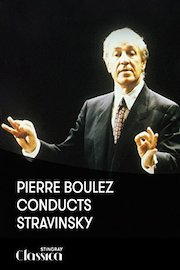
Pierre Boulez conducts Stravinsky

Where to Watch Pierre Boulez conducts Stravinsky

In the music documentary film, Pierre Boulez conducts Stravinsky, classical music enthusiasts are given a unique insight into the preparation and execution of an orchestral masterwork. World-renowned composer and conductor Pierre Boulez, at the helm of the esteemed L'Orchestre de Paris, brings his unparalleled interpretation to the works of another musical titan, Igor Stravinsky.
The movie opens by deliberately setting the stage, introducing the viewer to the grandiosity of classical music. We are led into the world of Boulez, a luminary of the music industry, who, at this point in his career, has received critical acclaim and had an audacious knack to interpret and implement intricate musical works.
Stravinsky, whose works are central to the film, was a seminal Russian composer, pianist, and conductor in the era of classical music. His works, vibrant and original, have inspired generations of composers and musicians. The two musical legends coming together in the film create a captivating and profound journey through music history.
Pierre Boulez conducts Stravinsky has an immersive narrative rather than a traditional plotline. It centres on Boulez preparing to direct L'Orchestre de Paris in a performance of Stravinsky’s compositions. The careful detailing of the entire process, starting from the selection of the compositions to the final applause, is a brilliant exploration of the professional perseverance and passion required in the realm of classical music.
This film also serves as an enlightening educational tool, particularly to those unfamiliar with Stravinsky's works. We discover Boulez's unique vantage point into the late composer's mind, as well as the in-depth analysis of the selected pieces. Boulez goes beyond the rote aspects of musical performance, providing a microscopic examination of each composition alongside his annotations of correspondence to Stravinsky's life and times. The audience are transported and enlightened about Stravinsky's world, his ideas, and his prominent place in musical history.
The movie goes through hours of rehearsals, dissecting each piece of music’s complex and complicated parts. There are close-ups of the conductor's hands, the orchestra's instrumentalists – the swift movement of bows, the tapping of violinists' feet, even the brief pauses for breath before each blowing into wind instruments. These elements carve a niche into the wide field of sight and sound that is so essential to the orchestra's synergy.
The actual concert performance is another highlight of the film. The conducting style of Boulez, precise, dynamic and passionate, a sharp contrast to Stravinsky's own conducting style, which was often described as restrained and economical, provides a new and fresh understanding of Stravinsky’s work. It is bound to leave both those well-acquainted with Stravinsky's oeuvre and fresh listeners in awe.
The synergy between Boulez and L'Orchestre de Paris is tangible. Despite the rigorous intensity of the rehearsals and the demanding nature of the compositions, the bonding between the conductor and the orchestra brings life and vigour to the performance. The individual skills of the master musician coupled with the collective sound brewing among the expert instrumentalists create an almost electrifying buzz of anticipation before the grand performance.
Ultimately, the film transcends being just a musical demonstration of a conductor leading an orchestra. It delves into the hearts of two immense musical figures, their contribution to the world of music, and the deep-seated devotion that continues their legacy.
In conclusion, Pierre Boulez conducts Stravinsky is an emotionally charged, musically rich cinematic essay about one master paying homage to another. It is a must-watch for music lovers and especially intriguing for those with a penchant for the meaty and robust history of classical music.