
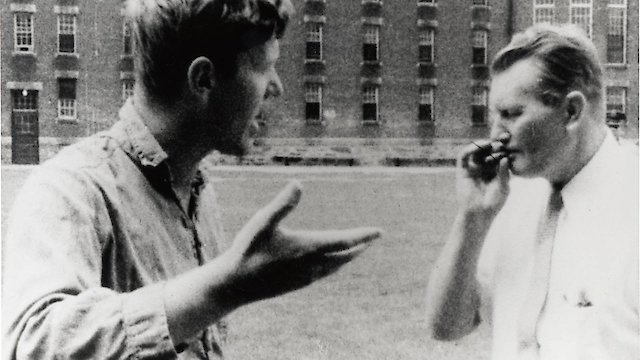
Titicut Follies
Titicut Follies
"Don't turn your back on this film if you value your mind or your life."
 7.7/10
Where to Watch Titicut Follies

Titicut Follies is a groundbreaking 1967 American documentary film directed by world-renowned documentarian Frederick Wiseman. The film is a stark, unflinching exploration of the conditions inside the Bridgewater State Hospital for the criminally insane, a Massachusetts correctional institution. The documentary sparked enduring conversations about mental health, ethics in documentary film, and the responsibilities of institutions supposed to care for the most vulnerable among us.
The title “Titicut Follies” comes from the Titicut Indian Pageant performed annually by the Bridgewater inmates, a somewhat peculiar and antiquated performance blending song-and-dance fare and snippets of history about the Native American tribe. The film features this performance as well as other facets of life inside the institution. Wiseman filmed continuous, uninterrupted sequences showing prisoners—inmates diagnosed with severe mental illnesses and declared crimically insane—negotiating their daily lives, many of them at the mercy of the prison staff.
Wiseman's vérité style of filmmaking captures the unvarnished realities of the institution, leaving viewers startled by the stark, harsh conditions in which the inmates were forced to live. Yet, even in this direct style of filming, Wiseman masterfully brings out the humanity of the inmates, showing them not as mere statistics or faceless figures in an institution, but as individuals with their unique stories and struggles.
Titicut Follies goes beyond the mere depiction of life in a correctional institution. It unravels the systemic issues embedded within the larger structural framework of such institutions, delving into brutal realities of neglected healthcare, human rights abuses, and the double punishment meted out to individuals who are both convicts and patients. Wiseman's observational lens never veers into sensationalism. Instead, his narrative remains truthful to the reality unfolding in front of the camera, putting forth a deeply disturbing vision of an institution meant to safeguard society while, ironically, seemingly failing to safeguard its inmates.
Perhaps the most striking aspect of Titicut Follies is the lack of any voice-over narration or an imposed perspective. The story unfolds through the interactions, conversations, and situations of the inmates and staff, and the viewers are left to draw their own conclusions. This narrative method allows for a pure, unmediated depiction of institutional reality, exemplifying Wiseman’s commitment to his fly-on-the-wall filming technique.
The power of Titicut Follies rests in its ability to shock and disturb. It forces viewers to confront harsh truths about mental health, criminal justice, and the way society often turns a blind eye towards the most marginalized. Even though Wiseman’s film is centered around a specific institution in a certain time and place, the core issues it raises are universally significant and continue to strike a chord more than five decades after its release.
Controversially, upon its release, Titicut Follies was deemed as intrusive and violating the privacy of the inmates by Massachusetts authorities, leading to legal battles that saw the film being banned for public screening. It was only in 1991 that the ban was finally lifted, allowing the general public to witness the harsh reality Wiseman had captured.
Even after all these years, Titicut Follies remains as one of the most heralded works of Wiseman and an exemplary instance of documentary filmmaking. The cinematic techniques, almost invisible editing, the sense of authenticity all work together to create a captivating, though uncomfortable, viewing experience.
Critics often cite Titicut Follies as a film that radically redefined the boundaries of documentary filmmaking and continue to study it for its approach that calls into question the human rights and the ethics of institutional care. Students of documentary films and those interested in social justice, mental health, and criminal justice may find this film particularly gripping and informative.
In essence, Frederick Wiseman's 1967 documentary, Titicut Follies, is a poignant, thought-provoking examination of life within a state institution for the mentally afflicted criminal population. It critically examines the dehumanizing treatment meted out to these often overlooked individuals, simultaneously spotlighting the inherent flaws within the mental health and incarceration systems. The echo of this haunting film continues to linger decades later, underlining the timeless relevance of the questions it poses and the realities it uncovers.
7.7/10