
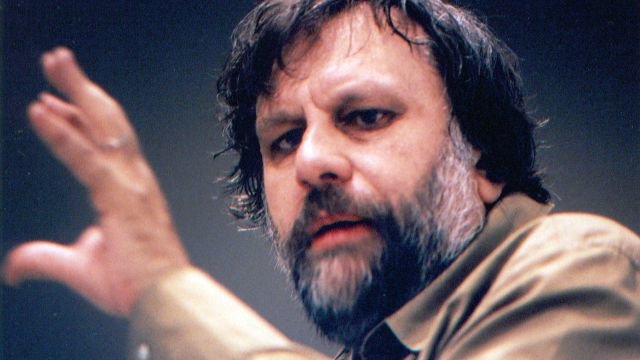
The Reality of the Virtual
The Reality of the Virtual
"A cinematic experience of Žižek's interpretations of reality and virtual reality."

Where to Watch The Reality of the Virtual

The Reality of the Virtual is a spectacular single-round cinematic exploration where the singular protagonist isn't battling extraterrestrial threats or maneuvering through a maze of mystery. Instead, the hero of the narrative is diving into a sea of ideas and philosophy. Directed by Ben Wright released in 2004, the movie stars Slavoj Žižek, a renowned Slovenian philosopher who often breaches the boundary of conventionality with his theories.
Tethered to the unassuming seat of a bare, abandoned classroom, the eccentric Žižek takes his audience on an intellectual voyage across the subtle terrains of ideology, belief, and reality. The movie is essentially a lecture, but don't be deceived into thinking it synonymous with mundane academia. Žižek, with his unconventional manner and infectious personality, immaculately breathes life into what could have been a monotonous affair.
The movie begins as an interrogation of reality, with Žižek proposing and dissecting the idea that our perceptions of 'real' are perpetually influenced and conditioned by our social, cultural, and psychological contexts. He threads this notion through various aspects of conventional wisdom and shared experiences, building towards an eloquent argument about the very essence of reality.
Conceived by Žižek, the title "Reality of The Virtual" might seem paradoxical, but it wonderfully encapsulates the central theme of the movie. Throughout the discussion, he amply uses popular cultural references, intertwining dense philosophical concepts with an array of movies and literature as aids. The extent of his discussion ranges from classical philosophy and psychoanalysis to contemporary pop culture and politics, blending it all together to create a fascinating whole.
However, do not mistake this for an easy, breezy philosophical romp. It delves into various complex and challenging theories such as the Lacanian psychoanalysis – a psychoanalytic theory that focuses on language and the structure of the unconscious. It deep-dives into metaphysics, discussing the complex relationship between being, non-being, and becoming.
Midway through the film, Žižek tactfully maneuvers the discussion towards belief and ideology. There, he expresses his view on the influence and impact of 'ideological fantasy' on shaping reality and the collective conscience of the society. With his trademark nuances, the philosopher underscores the ideological crisis in modern society, picking apart the contradictions that confound modern life, and interweaves it diligently with contemporary politics.
Throughout the film, Žižek continually invites the viewer to question their understanding of ‘the real’, contextualizing it in global happenings and personal experiences. In doing so, he unearths a fascinating paradox: despite our belief in rationality and objectivity, our perception of the world is cloaked in a matrix of cultural, social, and ideological subjectivities.
The Reality of the Virtual may not end on a neatly tied, conclusive note. However, it stimulates its viewers to rethink, reimagine and reevaluate their relationship with reality, belief, and ideology. It calls upon humanity to confront the contradictions that they've comfortably numbed down. The movie is a testament to Žižek's prodigious talent of being able to induce thought, debate, and introspection using the most unexpected analogies or sometimes even the most mundane observations.
With its intrinsic nature of discourse and invisible 'battle of ideas,' it might not be a movie that suits everyone's palate. The Reality of the Virtual can be described best as intellectual high cinema, one where the battlefield is the mind, and the weapon, a sturdy conveyor of philosophy called Slavoj Žižek.
With a running time of 71 minutes, this refreshing narrative steers clear from the tropes of traditional cinema, it won't serve you high-speed chases or heartbreaking romances. But for those who relish challenges or have a taste for philosophy and deep ideological reflections, venture into this world. This commendable endeavour of Ben Wright using Žižek's offbeat charisma and philosophy ticks the boxes of being enthralling, enlightening, and above all, thought-provoking.