
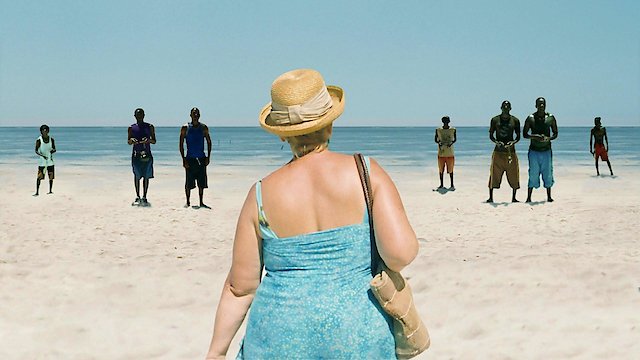
Paradise: Love
Paradise: Love
 7.0/10
 65/100
Where to Watch Paradise: Love

Paradise: Love is a poignant 2012 drama that delves deep into the socio-cultural aspects of contemporary society. Directed by visionary Austrian filmmaker Ulrich Seidl, who is recognized for his thought-provoking films, the movie is the first part of Seidl's Paradise Trilogy.
In Paradise: Love, Margarete Tiesel portrays the lead character, Teresa, a 50-year-old Austrian woman who embarks on a transformative journey. Disillusioned with her normal everyday life and frustrated with her chaotic love life, Teresa decides to take a vacation to Kenya's sun-drenched coastline. The film navigates her exploration of the African nation, her encounters with locals, and her newfound relationships, and realities.
Tiesel's performance is coupled by a compelling onscreen connection with Kenyan actor Peter Kazungu who plays Munga. Capturing the essence of today's society through their narratives, the interaction between Teresa and Munga forms the core of the narrative. As Teresa begins to involve herself in the so-called tourism of 'sugar mamas', affluent women who visit Kenya to buy the companionship of young men, the dynamics of her relationship with Munga unfolds complex realities of exploitation, manipulation, social class, and power imbalances both racially and economically.
The film also features Austria's acclaimed actress, Inge Maux, who plays another vacationer at the beach resort. Her character perpetually contrasts with Teresa's leading to an analysis of the different perspectives and attitudes of tourists and the locals on a broader canvas, beautifully juxtaposing stereotypes against realities.
Director Ulrich Seidl masterfully infuses his talent for documentary-style filmmaking into this narrative feature, leading to an objective yet empathetic viewpoint of a somewhat controversial topic. He scrupulously explores the complicated dynamics of sex tourism, leaving audiences with a wide space for their interpretation and contemplation. The film raises pertinent questions on issues like aging, loneliness, desire, and emotional fulfilment and balances these elements with softer moments of introspection and irony.
Paradise: Love's picturesque portrayal of Kenya isn't only a touristic showpiece of breathtaking vistas, pristine beaches, and charming vacation spots, but also an ironic tale of foreign exploitation. The cinematography combines bright and warm colour scales with long-shot frames, capturing the beauty of the locales while subtly hinting at the darker undertones of the storyline.
The dialogue is a mixture of Swahili and German, subtly underscoring the cultural and linguistic differences, which pervade the narrative landscape of this movie. The casual conversations, the gripping inveigles, and the articulate silences contribute to the overall ambience of this emotional drama.
Paradise: Love doesn't shy away from explicit subjects often left unspoken in mainstream cinema. Its sexual content is significant but never feels gratuitous, instead serving as essential components of the narrative that underline the dynamics between characters and their internal conflicts.
Tiesel's engaging and daring performance forms the backbone of the movie, and she flawlessly evokes a range of emotions, from vulnerability and confusion, to moments of fleeting joy and deep sadness. Peter Kazungu's portrayal of Munga enhances the complexities of the movie, revealing the bitter realities that are often hidden behind the simplistic perceptions of tourists.
In the end, Paradise: Love leaves its audiences with transformative insights into human vulnerabilities, desires, social realities, and moral questions. It portrays a heart-rending tale and navigates complex scenarios and human emotions brilliantly. It's a unique blend of raw narrative, compelling performances, stunning cinematography, and pointed social commentary, making it a must-watch for lovers of thought-provoking cinema.
7.0/1065/100