
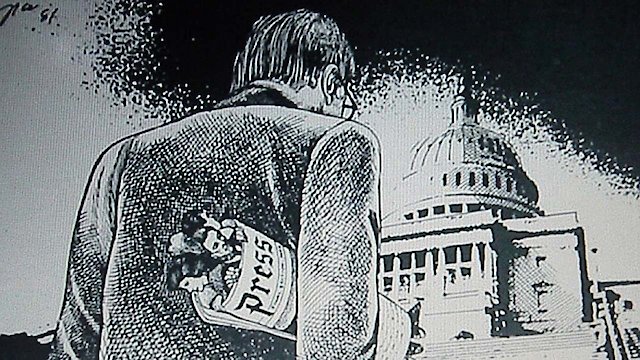
Orwell Rolls in His Grave
Orwell Rolls in His Grave
 8.0/10
 49/100
Where to Watch Orwell Rolls in His Grave

Orwell Rolls in His Grave is a 2003 documentary film directed and written by Robert Kane Pappas. It features notable figures such as Vincent Bugliosi, Jeff Cohen, and Dennis Kucinich among others. The title of the film is an allusion to George Orwell's groundbreaking dystopian novel 1984 and is a comment on what the director perceives to be the declining state of democracy in America. The film purports that Orwell's prophecy about a government that controls and manipulates the truth has been fulfilled to a disturbing extent in contemporary American society.
In the film, Pappas underscores his point by exploring the connection between big corporations, the political system, and the media. The investigation focuses on how these entities work together to control information and manipulate public opinion, which Pappas suggests is a direct threat to the democratic fabric of our society.
Vincent Bugliosi, Jeff Cohen, and Dennis Kucinich, among others, contribute to the film's argument with their insights and expertise. Bugliosi, a leading American attorney and author known for prosecuting the Charles Manson case, lends a deep understanding of the justice system and its vulnerability to manipulation. Jeff Cohen, a journalist, media critic, and founder of the media watchdog group FAIR (Fairness and Accuracy in Reporting) offers his expert analysis on the complex interplay between media and politics. Dennis Kucinich, a former U.S Congressman and a longstanding advocate for progressive causes, provides a clear lens into the political underpinnings of these machinations.
The main thread underlining Pappas’s breakdown is the role of the media and how it has passed under the control of a few gargantuan corporations. In the process, Pappas argues, media has become a vehicle for controlling the narrative and manipulating public opinion by cherry-picking the news it delivers and the way it frames these stories. The film raises critical and relevant questions about media bias, propaganda, the intermarriage of politics and business, and the resultant threat posed to the principles of a democratic society.
A key point Orwell Rolls in His Grave points to is the palpable shift in American democracy accused of morphing into a corporatocracy. Pappas leans into a deconstruction of high-profile political events and tangled narratives associated with media ownership to validate this perspective. The director presents an in-depth analysis of media monopolies, their influence over political discourse, and their increasing dominance over information dissemination.
Through a series of interviews, Pappas posits that media reform is the critical issue of our time. He suggests that it's crucial for the public to recognize and understand the extent of this influence so they can push back against it, mainly through education and awareness. By presenting detailed information about media consolidation and its impact, he stresses that an informed citizenry is fundamental to a healthy democracy.
The film also highlights the potential perils of unchecked corporate power, suggesting that it has overtaken governmental institutions, and in turn, endangering personal freedoms. It explores instances of corporations allegedly manipulating the political narrative and ensuring their economic interests are safeguarded at the expense of the public's rights to transparency and true democracy.
Orwell Rolls in His Grave is an eye-opening and thought-provoking documentary, pulsing with uncomfortable realities and poignant messaging. It delves into the impact of power structures on democracy and pushes viewers to question the information they consume daily. By critiquing the consolidation of power, Pappas encourages viewers to seek information from various sources and develop a critical understanding of the world around them.
While being a significant contribution to the political dialogue, the film is also a wake-up call for anyone interested in media studies, politics, or the way our culture handles the intersection of these two domains. With enough drama to stay interesting and enough facts to be informative, Orwell Rolls in His Grave straddles the line between being watchable and educational.
Overall, the audience of Orwell Rolls in His Grave will come away with a clear understanding of the film's message: that the growing harmonization between big business, media, and government should not go ignored. To do so would be to overlook the decreasing hold over our individual and collective capacity to influence the future of our own democracy. The ball, Pappas suggests, is in our court.
8.0/1049/100