
Kaidan

Kaidan
 6.1/10
Where to Watch Kaidan

Kaidan is a 2007 Japanese supernatural horror film directed by Hideo Nakata, a master craftsman of chilling and atmospheric thrillers, best known for his work on the original "The Ring" movie. Building on Japan's tradition of ghost-storytelling (Kaidan), Nakata unfolds a haunting narrative that explores themes of vengeance, salvation, reincarnations, and the thin line between the realms of the living and the dead.
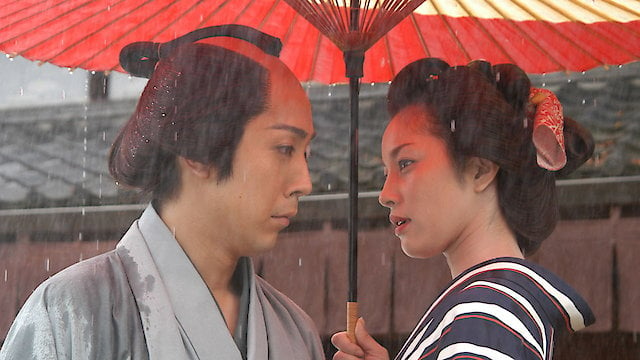
The film's protagonist is Shinkichi (Kikunosuke Onoe), a low-ranked samurai, whose innocuous appearance conceals a strong-willed character and stoicism typical of his class in feudal Japan. Shinkichi’s love interest and the second prominent character in Kaidan is the sweet, enchanting Oshiga (Hitomi Kuroki). The duo’s love story is gloriously beautiful, but it spirals into darker territories that Nakata deftly explores without rushing over any narrative development.
A strong supporting character comes in the form of Oshiga's younger sister, Ohisa (Mao Inoue), a character that brings in a fresh, youthful contrast to the unfolding drama. The script strategically places her as Shinkichi’s temptation, which leads to unfortunate circumstances that inevitably trigger fearful supernatural consequences.
While some audiences may find the film moving at a leisurely pace, the narrative builds tension and suspense in a slow-burn fashion, well-held by Nakata's astute directorial skills. This technique gives viewers time to fully comprehend the depth of the characters, understand their motivations, and empathize with their plight. This pacing is an essential part of Japanese ghost storytelling tradition, lending the movie a hypnotic, dream-like quality.
The cinematography, set designs, and color palettes of Kaidan are masterfully executed. The somber hues that dominate the scenes amplify the spectral atmosphere while mourning the tragic events. The dominance of dark blue and black shades paints a world where the boundary between the earthly and the supernatural is ever so blurred. Also, the usage of well-crafted, dimly lit sets imbuing the film with a sense of ethereal beauty, entrenches the viewer into a compelling, eerie universe of long-forgone era of Japan.
Kaidan is not just a story of supernatural retribution. At its core, it's a tragedy of human errors, a tale of love, and betrayal that transcends time. It pushes viewers to question the true nature of the characters—Would they have acted differently had circumstances been more favorable? Does their tragic end constitute an apt payback for their actions?
The movie also explores the role of socio-economic hierarchy in a feudal society. It shows how an individual's actions can be directed and limited by their societal status and how ambition above one's station can lead to personal degradation.
The spell-binding performance by the lead actors, Kikunosuke Onoe and Hitomi Kuroki, adds another dimension to the film. Onoe convincingly portrays the array of emotions Shinkichi grapples with: passion, guilt, sorrow, fear, and eventually, acceptance. Similarly, Kuroki brings out her character's complexities with an elegance that makes audiences root for her despite her role in the eventual catastrophe.
Mao Inoue, as the innocent yet wilful Ohisa, delivers a performance that is innocent yet forceful, making her character stand out in the narrator. As the name 'Kaidan' signifies a strange, spectral tale, Inoue plays an integral part in setting the eerie tone that pervades the movie.
Adding to the charm are the extraordinary costume designs that reflect the era's culture and contribute to the characterization. The enchanting soundtrack follows traditional Japanese music, masterfully heightening the suspense at critical junctures.
Kaidan is a movie that transports you into a world mixed with realism and the supernatural, where human errors bear supernatural consequences. It is a gripping tale of love, betrayal, punishment, and redemption. A must-watch if you are fascinated by Japan's culture, feudal societal undertones, samurai-class hardships, and, of course, the supernatural. Despite its tragic tonality, Kaidan reverberates with a profound essence of human fallibility and the attendant punishment, taking it beyond a ghost story into the realm of an age-old morality play. It is a beautiful contemporary recreation of classic ghostly Japanese folktales and as such, a worthy addition to Hideo Nakata's impressive horror oeuvre.
6.1/10