

Free For All!
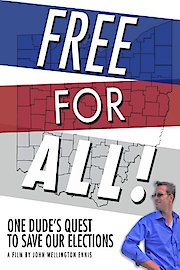
Free For All!
"One Dude's Quest to Save Democracy"
 8.7/10
Where to Watch Free For All!

Free For All! is a riveting political documentary from 2008 that delves into the intricate and often unknown aspect of the U.S election system. Directed by John Wellington Ennis and featuring the insightful contributions of Ken Blackwell and Greg Palast, the documentary aims to bring to light several explosive and essential questions about the integrity of the American democratic process. This controversial film offers a candid and critical examination of U.S election controversies, disappointments, and injustices that have been long ignored or belittled by mainstream media.
The film derives its title, Free For All!, from the irony of how American democracy, which is meant to be free and fair for all its citizens, could be manipulated by forces that desire to control the outcome. It emphasis how this can undermine the value and essence of a free choice and interfere with the fundamental democratic process. The powerfully charged feature-length documentary touches on profound subjects that are perhaps more relevant now than ever; especially for those who are committed to the principles of democracy, justice, and fair play in the American political arena.
John Ennis, who is known for his distinct storytelling style and passion for social justice, uses his directorial ability judiciously in this film. He embarks on a cross-country adventure to unravel the presumable irregularities in the American voting system. His journey takes him through several states, visiting precinct stations, local communities, and party headquarters whilst interacting with key political figures, statisticians, election officials, and ordinary voters who have experienced firsthand the often bewildering procedure of casting their vote.
Ken Blackwell, one-time Secretary of State for Ohio and a key figure in the 2004 U.S. Presidential election, and Greg Palast, a celebrated investigative journalist who has dedicated his career to unveiling political corruption, both play significant roles in the film. They provide expert commentary, candid interviews, and personal anecdotes. They help us understand the intricacies of the election system, its vulnerabilities, and various manipulative tactics employed that challenge its credibility. Their narratives provide counterpoint perspectives that prompt viewers to question the fundamentals of the democratic process in the United States.
"Free For All!" is a whistleblower's account, drawing attention to specific cases and incidences such as vote flipping, voter suppression, purging of voter rolls, and irregularities in voting machine counts. Its approach duly inclines towards the investigative, observational, and the provocative, creating an indispensable dialogue within the American society about the core principles that uphold democratic values.
The stylistic choices of the film appeal to the modern audience. The documentary alternates between direct interviews, archive footage, data visualisations, personal narratives, and Ennis' own on-the-road reporting style. The narrative is kept engaging with quick cuts, close-ups, background scores, and true-to-the-moment reactions from the interviewees. These choices make "Free For All!" not only a critical investigation on a complex subject but also an entertaining watch.
"Free For All!" is an excellent pick for political enthusiasts, election observers, and anybody interested in the American democratic process. It is a wake-up call for the citizens and policymakers alike to review and revise the current electoral system for more accountability and transparency. Warmly received by audiences, "Free For All!" has been praised for its ability to shed light on a complex issue through a fascinating yet accessible narrative style.
In conclusion, this documentary is more than a simple examination of an explored subject; it's brilliant storytelling that carries a timely, sobering message. "Free For All!" asks us to reconsider the systems we trust and urges us to become more proactive participants in our democracy. Ennis, Blackwell, and Palast provide viewers with the opportunity to not only contemplate these critical issues but also promotes the audience's engagement towards a better and truly democratic America.
8.7/10